




 Chat Now
Outdoor Media LED display panels represent the pinnacle of modern advertising technology, fundamentally transforming the landscape of out-of-home (OOH) marketing. These are not merely digital replacements for static billboards; they are dynamic, intelligent, and networked communication platforms engineered to dominate the visual environment. Designed for permanent installation in high-traffic locations, these displays combine monumental scale with dazzling brightness to capture attention, convey messages, and create lasting brand impressions 24 hours a day, 365 days a year, regardless of environmental conditions.
The evolution from static posters to digital LED billboards marks a paradigm shift in advertising philosophy. Traditional billboards are passive, offering a single message for weeks or months. In contrast, LED digital billboards are active, agile mediums. They enable advertisers to run multiple campaigns simultaneously, change messages instantly based on time of day, audience demographics, or real-world events, and even display live data feeds, social media content, and emergency alerts. This agility allows for unprecedented targeting and relevance, turning previously broad-scale brand awareness tools into precision instruments for driving specific consumer actions.
The market for outdoor LED media is vast and growing exponentially, fueled by its demonstrated effectiveness. Advertisers value the measurability, flexibility, and high impact that digital OOH offers compared to other media. A prime location on a major highway or in a city center can deliver millions of impressions daily to a captive audience of drivers and pedestrians. The technology has become sophisticated enough to offer zoning capabilities, allowing a single large-format display to show multiple adverts from different brands simultaneously, maximizing revenue potential for the media owner.
The core of this technology is the LED display panel itself—a modular system built to withstand the relentless assault of the outdoor elements. Unlike indoor screens, these panels are fortresses of engineering, designed to resist rain, snow, dust, extreme heat, freezing cold, and constant UV radiation. Their defining characteristic is ultra-high brightness, typically ranging from 6,000 to over 10,000 nits, ensuring that content remains vibrant and legible even under the harsh glare of direct midday sun. This ensures that the advertiser's investment is visible and effective throughout the day.
Furthermore, these displays are no longer isolated units. They are nodes in a vast networked ecosystem. Managed remotely via cloud-based software, a company can control a nationwide network of billboards from a single office, updating content, monitoring performance, and gathering data seamlessly. This connectivity enables programmatic advertising, where ad space can be bought and sold in real-time, much like online digital advertising, bringing a new level of automation and efficiency to the OOH industry.
In summary, outdoor media LED display panels are the cornerstone of 21st-century OOH advertising. They are complex feats of electrical, mechanical, and software engineering that have created a new, dynamic visual layer atop our urban and highway environments. They offer advertisers an unmatched combination of scale, flexibility, and impact, making them one of the most powerful tools for building brand awareness and driving consumer engagement in the physical world.
The design and construction of an outdoor LED billboard panel is a masterclass in ruggedized engineering, balancing the demanding requirements of extreme environmental protection, structural integrity, thermal management, and optical performance. Every component, from the smallest diode to the largest structural member, is meticulously selected and tested to ensure uninterrupted operation for years in the most challenging conditions.
A. Core Design Philosophy: Resilience and Reliability
The overarching design principle is "fit and forget." Once installed, these panels must operate continuously with minimal maintenance. This dictates:
Maximum Environmental Sealing: Achieving a minimum IP65 rating (dust-tight and protected against water jets) is mandatory, often extending to IP67 for added security in flood-prone areas.
Structural Robustness: The panel and its support structure must withstand high wind loads (as per local building codes, often up to 200 km/h), seismic activity, and potential impact from debris.
Corrosion Resistance: All metals, fasteners, and connectors are made from stainless steel or aluminum with advanced powder coatings to resist corrosion from rain, humidity, and pollution.
Thermal Stability: The system must manage heat generated by high-brightness LEDs and absorbed solar radiation across a vast operating temperature range (e.g., -40°C to +50°C).
B. Key Components and Materials:
LED Modules: The Image Engine
LED Type: High-brightness Surface-Mount Device (SMD) LEDs in a -in-1 configuration are standard. These integrate red, green, and blue chips into a single robust package, offering excellent color mixing, wide viewing angles, and reliability.
Potting and Sealing: This is the critical differentiator from indoor panels. The entire module undergoes a potting process. It is filled with a transparent, flexible silicone gel that encapsulates the LEDs, driver ICs, and circuitry. This protects against moisture ingress, thermal cycling stress, vibration, and corrosion, dramatically extending lifespan.
PCB Substrate: Uses high-quality, thick copper FR-4 material with a special anti-UV solder mask and conformal coating for an additional layer of protection.
Face Mask: A deep, matte black mask surrounds each LED to absorb ambient light and drastically improve contrast ratio, which is crucial for sunlight readability.
Cabinet Frame: The Structural Chassis
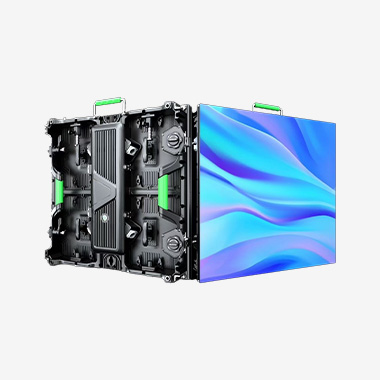
Material: Heavy-duty extruded aluminum alloy is used for its excellent strength-to-weight ratio and natural corrosion resistance. Cabinets are designed to be interlocking and easily mounted onto a steel support structure.
Sealing: Silicone rubber gaskets are used on all seams and access panels. These gaskets are designed to maintain their elasticity and sealing properties over years of thermal expansion and contraction.
Access and Serviceability: Despite being sealed, cabinets are designed for maintenance. Rear service access doors with robust latches allow technicians to replace modules or components without dismantling the entire display.
Thermal Management System: The Climate Control
Active Cooling: Passive cooling is insufficient. Outdoor cabinets employ a sophisticated active cooling system.
IP-Rated Axial Fans: High-volume, IP65-rated exhaust fans are mounted at the top of the cabinet to expel hot air.
Louvered Intakes: IP65-rated intake vents with fine mesh dust filters are located at the bottom. This creates a chimney effect, drawing in cool air which is heated by the components and naturally rises to be expelled by the fans.
Heaters: Thermostatically controlled heating elements are installed to prevent condensation inside the cabinet during cold, humid weather—a primary cause of electronic failure.
Power and Data Infrastructure:
Power Supply Units (PSUs): Industrial-grade, high-efficiency (90%+) switching PSUs are used. They are designed for a wide input voltage range and are protected against power surges and lightning strikes.
Wiring and Connectors: All internal wiring is high-temperature rated. External data and power connections use robust, locking, and weatherproof connectors (e.g., IP67-rated Harting or Amphenol connectors) to prevent disconnection and ensure signal integrity.
C. The Supporting Structure and Installation:
The panels are mounted onto a custom-designed primary steel structure, which is firmly anchored to a concrete foundation. The design of this structure requires rigorous engineering analysis for dead loads (weight), live loads (wind, snow), and dynamic loads. The installation process is a major operation involving cranes, certified riggers, and electricians, culminating in a structure built to last for decades.
The construction of an outdoor LED billboard panel is a testament to over-engineering for reliability. It is a fully integrated system where electrical, mechanical, and environmental design work in concert to create a visual workhorse capable of thriving in the great outdoors.
The working principle of an outdoor LED billboard is a continuous cycle of data management, precision light control, and environmental self-regulation. It's a complex orchestration of electronics and software designed to produce a brilliantly stable image while battling the unpredictable outdoor elements.
A. Image Formation: High-Power Electroluminescence and Control
At the pixel level, the technology relies on electroluminescence within semiconductor materials.
High-Output LEDs: The LEDs used are specifically engineered for luminous efficacy, producing a massive amount of light (measured in lumens) per watt of electrical power. This is essential for achieving the 8,000+ nits brightness required to overcome ambient sunlight.
Pulse-Width Modulation (PWM): The intensity of each red, green, and blue LED is controlled with exquisite precision using PWM. Instead of varying the current (which would alter the color output), the driver ICs switch each LED on and off at a very high frequency (thousands of times per second). The human eye perceives the duty cycle (the ratio of "on" time to "off" time) as a change in brightness. A longer "on" pulse results in a brighter perception. This method allows for perfect grayscale reproduction and color depth.
B. The Intelligent Signal Chain:
Content Creation and Scheduling: Content is designed to the billboard's specific resolution and uploaded to a cloud-based Content Management System (CMS). Here, playlists are created, scheduling different ads for specific times of the day, days of the week, or even triggering them based on external data feeds.
Data Transmission: The CMS communicates with the billboard's on-site controller via a secure internet connection (often a wired fiber optic or robust 4G/5G cellular link).
On-Site Control and Processing: A dedicated industrial computer or controller is housed in a weatherproof cabinet at the base of the billboard. This is the brain of the operation. It performs several critical functions:
Content Storage and Playback: It stores the scheduled content and plays it back.
Video Processing: It takes the video signal, scales it to the native resolution of the LED wall, and performs color correction and image enhancement.
Data Distribution: It packetizes the image data and distributes it via a network of cables to the receiving cards located in each individual LED cabinet. The network is typically arranged in a ring topology for redundancy; if one cable fails, the signal can travel the other way around the loop.
Cabinet-Level Execution: Each LED cabinet contains one or more receiving cards. These cards take the data packets intended for their section of the display and send commands to the driver ICs on the LED modules. The driver ICs are the final link, executing the PWM commands that physically control the light output of each individual sub-pixel.
C. Autonomous Environmental Management:
The "operation" of the billboard is largely autonomous, thanks to a network of sensors.
Automatic Brightness Control (ABC): An ambient light sensor (photocell) continuously measures the sunlight intensity falling on the display. The controller automatically adjusts the LED power output from 100% at noon to a significantly reduced level at night. This is critical for energy savings, reducing light pollution, and complying with local ordinances that often mandate dimming after dark.
Thermal Management: Temperature and humidity sensors inside the cabinets provide constant feedback to the controller. If temperatures rise too high, the cooling fans are activated. If temperatures drop and humidity rises, the heaters are engaged to prevent condensation. This proactive system ensures components operate within their safe specifications, maximizing their lifespan.
This sophisticated, self-regulating system ensures that the billboard delivers a consistent, brilliant, and reliable advertising message around the clock, adapting seamlessly to the changing environment without the need for constant human intervention.
The adoption of LED technology for billboards offers a compelling array of advantages that have driven its widespread success, but these are counterbalanced by significant technical, financial, and regulatory challenges that must be carefully managed.
Advantages:
Unmatched Impact and Visibility: The combination of massive size, dynamic motion, and ultra-high brightness creates an advertising medium that is virtually impossible to ignore. It commands attention in competitive visual environments, generating immense brand exposure and superior recall rates compared to static billboards.
Unprecedented Flexibility and Real-Time Marketing: Advertisers can change messages instantly and remotely. This enables:
Dayparting: Promoting coffee in the morning and restaurants in the evening.
Relevance: Reacting to weather (e.g., sunscreen ads on hot days), traffic conditions, or live sports scores.
Multiple Advertisers: A single digital billboard can host 6, 8, or even 10 different advertisers, rotating their messages every 6-10 seconds, maximizing revenue for the media owner.
Enhanced Measurability and Accountability: Digital billboards can be integrated with data analytics. While privacy-compliant, they can use anonymized mobile data to gauge audience reach, demographics, and even travel patterns. This provides advertisers with metrics akin to digital media, moving OOH from a purely awareness medium to a more measurable one.
Potential for Higher Return on Investment (ROI): Despite higher initial costs, the ability to host multiple advertisers and charge a premium for prime time slots can lead to a much faster payback period and higher long-term revenue than a static billboard. For advertisers, the agility to run short-term, targeted campaigns improves marketing efficiency.
Public Service and Emergency Communication: Digital billboards can be instantly taken over by government authorities to broadcast Amber Alerts, severe weather warnings, traffic information, and other critical public safety messages, providing a valuable service to the community.
Challenges:
Prohibitive Initial Capital and Operational Expenditure: The cost of the LED panels, the heavy-duty support structure, professional installation, and electrical work represents a very large capital investment. Operational costs, primarily electricity for powering the high-brightness LEDs and the cooling systems, are also substantial.
Regulatory and Permitting Hurdles: Obtaining permits for digital billboards is often a complex, lengthy, and contentious process. Many municipalities have strict regulations regarding size, location, brightness levels (especially at night), sign spacing, and duration of content rotation. Public opposition on aesthetic grounds ("light pollution" or "visual clutter") is common.
Technical Complexity and Maintenance Demands: The systems are complex and require specialized knowledge to maintain. While designed for reliability, components like fans, power supplies, and individual LED modules can fail. Diagnosing and repairing these issues on a structure that may be 50 feet in the air requires skilled technicians with specialized lifting equipment, making maintenance events complex and costly.
Content Production Costs and Demands: The effectiveness of the medium hinges on high-quality content. Static images are not enough; engaging motion graphics and video are required to capture attention. This necessitates ongoing investment in professional content creation, which can be a significant additional cost for advertisers.
Environmental and Community Concerns: The high energy consumption of these displays contributes to their carbon footprint. Furthermore, concerns about driver distraction and the potential for light pollution to affect nearby residents and wildlife are ongoing challenges that the industry must address through technological improvements and responsible practices.
In conclusion, while the advantages of dynamic communication, revenue potential, and impact are profound, successfully deploying an outdoor LED billboard requires navigating a maze of financial, technical, and regulatory challenges. A thorough feasibility study and partnership with experienced providers are essential for success.
The application of LED technology has fundamentally expanded the role of the billboard from a simple advertising space to a multi-functional digital platform. Concurrently, technological innovation is rapidly shaping its future, pushing it towards greater intelligence, interactivity, and integration.
Applications:
Highway Advertising: Large-format digital billboards along major highways and interstates target a captive audience of long-distance travelers and daily commuters. Their size and brightness are designed for long-range visibility and high-speed comprehension.
Urban Digital Spectaculars: Iconic locations in city centers (e.g., Times Square in New York, Piccadilly Circus in London) feature the largest and most advanced LED billboards. These "spectaculars" are as much tourist attractions as they are advertising mediums, offering brands a global platform for prestige and mass awareness.
Retail and Point-of-Sale Promotion: Billboards located near shopping malls, automotive dealerships, or large retail stores are used for tactical, proximity-based advertising. They can promote daily specials, drive foot traffic, and reinforce brand messages at the critical point of sale.
Stadiums and Entertainment Venues: Surrounding sports arenas, concert halls, and race tracks, digital billboards advertise upcoming events, sponsors, and concessions to fans attending events and passing traffic.
Airports and Transportation Hubs: In these environments, billboards target a high-value audience of business travelers and tourists. Advertising often focuses on luxury brands, financial services, travel amenities, and local attractions.
Future Trends:
Programmatic DOOH (pDOOH) Integration: This is the most significant trend. Programmatic technology automates the buying and selling of ad space on digital billboards in real-time through digital platforms. Advertisers can use data triggers (e.g., weather, traffic, sports scores, flight arrivals) to automatically launch targeted campaigns, bringing the efficiency and targeting of online advertising to the physical world.
3D and Anamorphic Content: Advanced content creation techniques are being used to create optical illusions of depth and objects extending beyond the physical frame of the billboard. This "3D without glasses" effect, achieved through clever creative design, generates immense social media buzz and audience engagement.
Increased Interactivity and Personalization: Future billboards will move beyond broadcast to interact with audiences.
Mobile Integration: Using QR codes or NFC technology, viewers can instantly interact with the ad, downloading coupons, accessing websites, or following social media accounts.
Audience Recognition: With privacy-focused, anonymized sensors, billboards could detect general audience demographics (e.g., a group of young adults vs. a family) and adjust the displayed content to be more relevant to that group in real-time.
Sustainability Drive: Energy efficiency will become a paramount concern.
Improved LED Efficiency: Ongoing development of LEDs that produce more light per watt will directly reduce operational costs and environmental impact.
Integrated Solar Power: Billboards may incorporate solar panels into their structure to offset a portion of their energy consumption.
Adaptive Power Management: Smarter systems will deeply dim displays during very low-traffic hours or when no audience is detected, going far beyond simple day/night dimming.
Transparent LED Technology: The adoption of transparent LED film will create new application opportunities. It could be applied to the glass facades of buildings at street level, allowing for digital advertising while maintaining outward visibility from inside the building, thus addressing some aesthetic concerns.
The future of the outdoor LED billboard is intelligent, responsive, and sustainable. It will evolve from a simple display into a connected, data-driven node in the smart city ecosystem, offering deeper engagement and greater value for advertisers and communities alike.
Conclusion
Outdoor Media LED display panels have irrevocably redefined the billboard, transforming it from a passive relic of traditional advertising into a dynamic, intelligent, and dominant force in the modern marketing mix. They represent the successful convergence of digital technology with physical space, creating a medium that offers the scale and impact of OOH with the flexibility and measurability of digital media. This synergy has secured their position as an indispensable tool for brands seeking to build mass awareness and drive consumer action.
The success of this technology is a testament to extraordinary engineering achievement. Overcoming the formidable challenges of the outdoor environment required innovations in sealing, thermal management, and structural design, resulting in a product that is both ruggedly reliable and brilliantly effective. The ability to deliver stunning visual clarity in full sunlight is a feat that underpins the entire value proposition of the digital billboard.
However, the hardware is only part of the story. The true transformation has been enabled by software and connectivity. Cloud-based management systems and the advent of programmatic buying have unlocked unprecedented agility and efficiency, allowing advertisers to wield these massive displays with a precision once thought impossible for out-of-home media. This has elevated the billboard from a broad-awareness tool to a strategic, data-informed channel capable of delivering relevant messages in real-time.
Looking ahead, the trajectory is clear. The billboard will continue to evolve from a broadcast monologue into an interactive dialogue. Trends like pDOOH, 3D content, and mobile integration point towards a future where these displays are seamlessly woven into the fabric of the smart city, responding to their environment and their audience. The ongoing focus on sustainability will ensure this growth is responsible, mitigating environmental impact through technological progress.
In conclusion, the LED media panel has not just replaced the static billboard; it has fundamentally expanded its purpose and potential. It is a powerful testament to how technology can reinvent a traditional medium, offering a potent blend of artistic canvas, communication platform, and data-driven workhorse. As we look towards the future of urban landscapes, the dynamic glow of the LED billboard will undoubtedly remain a central, evolving, and influential feature of our shared visual experience.


Copyright © 2026 Shenzhen Cogo Technology Co.,Ltd.
All Rights Reserved

 Previous article