




 Chat Now
LED display event signage has revolutionized the live experience industry, transforming events from passive viewings into immersive, multi-sensory spectacles. Unlike their outdoor advertising cousins, which are designed for durability and long-term deployment, event signage is the chameleon of the LED world—high-resolution, versatile, and often temporary, built to create a powerful impact within a condensed timeframe. From the subtle elegance of a corporate keynote to the explosive energy of a music festival, these displays form the dynamic visual core that defines and elevates contemporary events.
At its essence, event LED signage is a modular, high-performance visual system used to display video content, graphics, live feeds, and interactive elements to an audience. Its primary purpose is to amplify the event's message, engage the audience, and create a shared visual context that can be seen clearly from every seat in the house. The shift from static physical sets and projection screens to vibrant, moving LED walls represents a paradigm shift in event production. It offers unparalleled creative freedom, allowing organizers to change the entire atmosphere of a venue with the click of a button.
The ecosystem of event signage is diverse, catering to a wide range of scales and applications. It encompasses:
Massive Stage Backdrops: The most common use, forming the main visual canvas behind performers at concerts, theatre productions, and large conferences.
IMAG (Image Magnification) Screens: Large screens flanking the stage that show live video feeds of the speakers or performers, ensuring those in the back can see details and emotions.
Rental and Staging: A significant portion of the event market relies on rental companies that own, maintain, and deploy these expensive systems for temporary events. This model makes cutting-edge technology accessible without a massive capital investment.
Broadway and Theatre: Ultra-fine pitch LEDs are now standard in theatrical productions, creating dynamic, moving sets that can transport the audience from a castle to a forest in an instant.
Corporate Events: Product launches, galas, and trade shows use LED walls for branding, presentations, and creating "wow" factor booths.
The driving force behind the adoption of LED in events is its superior performance compared to traditional projection. LEDs are brighter, eliminating issues with ambient light washing out the image. They offer true black levels and richer colors, creating a more vivid and compelling picture. They are also not susceptible to shadows being cast onto the screen, allowing speakers to walk in front of the content without disruption.
This overview introduces the critical role of LED technology in shaping modern events. It is a tool for storytellers, a canvas for artists, and a communication medium for brands. The following sections will delve into the specific design considerations that make these displays so effective, the intricate principles that power them, the advantages they hold over other technologies, the vast array of applications they serve, and the exciting future trends that promise to make events even more immersive and unforgettable.
The design and construction of LED displays for events are fundamentally different from those for permanent outdoor installations. The priorities shift from extreme weatherproofing and multi-decade durability to factors like weight, ease of assembly, visual fidelity, and versatility. An event LED system is a precision instrument built for rapid deployment, stunning performance, and reliable operation under the intense pressure of a live show.
Core Components Tailored for Events:
LED Modules and Panels: The heart of the system. For events, the pixel pitch—the distance between pixels—is paramount. Unlike outdoor billboards with pitches of P4-P10, event signage demands much finer resolutions, typically ranging from P2.5 to P10mm, with high-end shows often using P1.2 to P2.5 for close-viewing applications. The modules are built on lightweight PCBs and are designed for high refresh rates (≥3840Hz) to eliminate camera scan lines and ensure smooth video playback. Color consistency and calibration are exceptionally strict to avoid any visual patches or irregularities on screen.
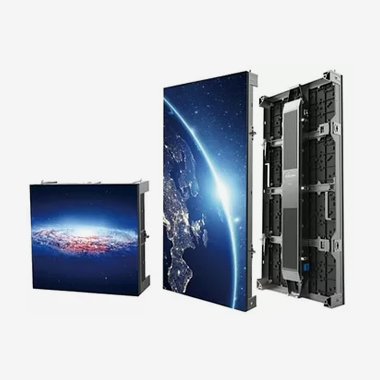
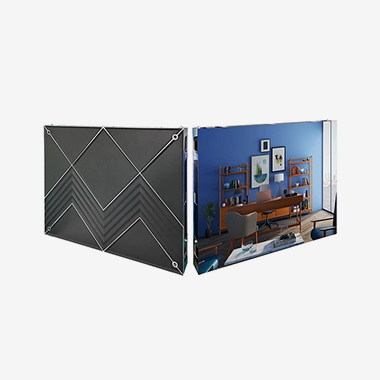
Cabinet Structure: This is where event design truly diverges. Instead of heavy, die-cast aluminum IP65 cabinets, event displays use lightweight, quick-assembly frames. Common types include:
Lightweight Magnetic Panels: The gold standard for rental. Modules are attached to a lightweight aluminum frame via strong magnets, allowing for incredibly fast installation and breakdown. A single technician can often pop a module on or off in seconds.
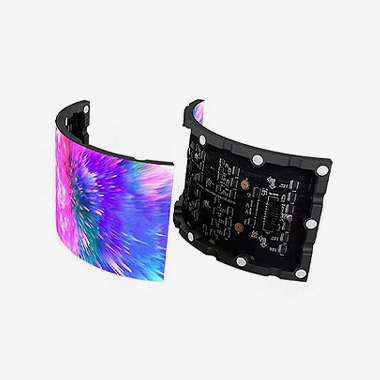
Curtain / Mesh Panels: Flexible, soft panels that are incredibly lightweight and can be hung in curved or unconventional shapes. They are not as robust as rigid panels but offer unique creative possibilities for draping or wrapping structures.
Creative Shapes: Beyond flat walls, manufacturers now produce pre-fabricated curved panels, hexagons, triangles, and circles that can be assembled into 3D video sculptures and immersive tunnels.
Structural Support Systems: The entire LED wall must be supported by a safe and adaptable truss and rigging system. Event production companies use industry-standard aluminum trussing and professional rigging hardware (motors, chains, safety cables) to fly the displays above the stage or ground-support them. The entire structure must be engineered to handle the weight and wind load (if outdoors) and be certified for safety.
Power and Data Distribution: Event systems are designed for plug-and-play functionality. Power is distributed via Power Distribution Units (PDUs) with circuit breakers, and data runs in a redundant, daisy-chained network from the video processor to the receiving cards in each cabinet. Locking connectors (like PowerCON and EtherCON) are used to prevent accidental disconnection during a show—a critical fail-safe.
Video Processing - The Brain of the Operation: This is arguably the most complex and vital component. An event-grade video processor (e.g., from brands like Novastar, Brompton, or Christie) does far more than just scale video. Its advanced features include:
Advanced Calibration: Per-pixel calibration for flawless color and brightness uniformity across the entire wall, even when mixing panels from different batches.
Scaling and Mapping: Handles multiple input sources, maps them to the often non-standard resolution of the LED wall, and can even warp and blend content to fit curved or irregular surfaces.
Redundancy: High-end processors offer redundant power supplies and hot-swappable input cards to ensure the show will go on even if a hardware component fails.
Design Philosophy: The "Rig-able, Strike-able, Truck-able" Mantra
Every aspect of an event LED display is designed around the rental cycle: it must be easy to rig (install), easy to strike (dismantle), and must be truck-able (able to withstand the rigors of transportation in flight cases). Modules and cabinets are built to be handled frequently, with reinforced corners and robust connectors. They are packed into custom-fitted, shock-absorbing flight cases that protect the multi-million-dollar investment as it travels from warehouse to venue and back again.
This focus on modularity, weight savings, and rapid deployment, all while maintaining broadcast-level image quality, makes the design and construction of event LED signage a unique and highly specialized engineering discipline.
The working principles of an event LED display share a common foundation with all LED technology—using PWM to control RGB diodes—but the demands of live events push these principles to their out, requiring exceptional speed, precision, and reliability to avoid any visible glitches during a performance.
The High-Speed, High-Fidelity Data Chain:
Signal Acquisition and Management: A live event typically has multiple video sources: a presentation laptop, a live camera feed for IMAG, pre-recorded video content, and sometimes live feeds from other locations. These signals are fed into a video switcher (e.g., from Blackmagic Design or Ross Video) where a director chooses which source to "send" to the LED wall. The output from the switcher is then sent to the LED video processor.
The Video Processor's Crucial Role: The processor is the intelligent hub. It takes the incoming signal (e.g., a 1080p feed) and scales it up to the native resolution of the entire LED wall, which might be an unusual, non-standard size like 2560x1440 pixels. For complex setups with curved walls or multiple screen sections, the processor uses warping and blending algorithms to mathematically distort the image so it looks perfectly correct from the audience's perspective. It also manages color space conversion (e.g., from REC.709 to the display's specific color gamut).
Data Transmission with Redundancy: The processed data is output from the processor via DVI, SDI, or fiber optic cables. In a critical live event environment, redundancy is key. A standard practice is to use a "primary" and "backup" processor, or to send the data signal through two separate paths (A and B) to the LED tiles. If the primary path fails, the system can automatically switch to the backup with no interruption to the show.
Pixel Driving and the Refresh Rate Imperative: Inside each LED panel, receiving cards and driver ICs take the data packet and control the LEDs. For events, two driving metrics are critically important:
Refresh Rate: This is how many times per second the display redraws the image. A low refresh rate (e.g., 60Hz) can cause flickering, especially when recorded by video cameras. Event displays feature very high refresh rates (often 3840Hz or higher) to ensure completely stable, flicker-free performance for both the live audience and any broadcast cameras. This eliminates the rolling black bars (scan lines) that would otherwise ruin a professional video recording of the screen.
Gray Scale Depth: This refers to the number of brightness levels each color can produce. Standard is 16-bit processing, allowing for over 65,000 levels of intensity per color. This is essential for producing smooth color gradients and preventing "banding"—visible stripes in areas that should be a smooth blend of color, like a sky.
Real-Time Monitoring and Control: Throughout the event, a video engineer monitors the system from a dedicated console. Using specialized software, they can see the status of every cabinet—temperature, voltage, and data integrity. They can make real-time adjustments to brightness or color balance to compensate for changing ambient light conditions in the venue. This constant vigilance is what ensures a flawless visual experience from the first minute to the last encore.
The working principle of an event LED display is a symphony of synchronized technology. It's about taking multiple, often chaotic inputs, processing them with immense power and intelligence, and distributing them with flawless reliability to millions of individual pixels, all operating at breathtaking speed to create a single, seamless, and stunning visual canvas.
The adoption of LED technology in the events industry has been meteoric, but it is driven by a clear set of compelling advantages. However, for event producers and rental companies, these advantages come with a unique set of challenges and considerations that must be carefully managed.
Advantages:
Unmatched Brightness and Viewing Quality: This is the most significant advantage over projection. LEDs produce their own light, making them clearly visible in fully lit environments. This allows the house lights to stay on during presentations, fostering audience connection while they can still see the stunning visuals. They also offer superior contrast ratios with true blacks, resulting in a more dynamic and vibrant image.
Creative Flexibility and Dynamic Sets: An LED wall can become anything: a news desk, a fiery explosion, a tranquil forest, or a data dashboard. It eliminates the cost and labor of building, painting, and storing physical sets. Content can be changed in an instant, allowing for a rapid narrative pace and the ability to make last-minute updates.
Space Efficiency and Design Freedom: Projectors require a long "throw distance" and clear sightlines, which can be impossible in some venues. LEDs have no such requirement; they are the screen and the light source in one. This allows for stages to be designed with more space for performers and set pieces. Furthermore, flexible and curved panels enable the creation of immersive environments that wrap around the audience.
Reliability and Consistency: Once calibrated, an LED wall delivers consistent color and brightness across its entire surface. There are no lamps to burn out mid-show (as with projectors), and the modular nature means a single failing module can be swapped out quickly, often without the audience even noticing.
Integration with Live Video (IMAG): LEDs are perfect for Image Magnification. There is no latency or loss of quality when displaying live camera feeds, ensuring the audience gets a crisp, real-time view of the action on stage, which is crucial for engagement in large venues.
Challenges:
High Cost of Acquisition and Operation: The initial investment in a high-resolution LED system is substantial. For rental companies, this is compounded by the high cost of maintenance, transportation (trucks, fuel, flight cases), and insurance. This cost is ultimately passed on to the client, making LED one of the more significant line items in an event budget.
Logistical Complexity and Labor Intensity: Transporting, installing, and configuring an LED wall is a major logistical operation. It requires a skilled crew of video technicians, riggers, and electricians. A large-scale install can take days of setup and testing, requiring careful project management and coordination with other vendors.
Technical Expertise and Failure Points: While reliable, the system is complex. It requires highly trained staff to configure the processor, calibrate the wall, and troubleshoot issues under extreme time pressure. A single faulty cable, connector, or power supply can cause a section of the wall to go black, creating a major crisis during a live event.
Weight and Rigging Challenges: Even lightweight LED walls are heavy when assembled into a large surface area. The structural engineering and rigging requirements are non-trivial. The weight load must be calculated and approved by a certified structural engineer to ensure the safety of everyone in the venue.
Content Demands: The resolution of an LED wall is often non-standard, requiring content to be custom-designed for the specific canvas. Simply projecting a 16:9 PowerPoint presentation onto a massive, oddly-shaped wall will result in poor quality. This necessitates additional investment in professional content creation, often with motion graphics designers who understand how to leverage the medium effectively.
For most event professionals, the advantages of visual impact, flexibility, and reliability far outweigh the challenges. However, a successful LED-based event requires meticulous planning, a generous budget, and a trusted team of technical experts to navigate these potential pitfalls.
The application of LED display technology in events has exploded beyond the simple stage backdrop, permeating every facet of the live experience industry. Concurrently, the technology is evolving at a rapid pace, opening new frontiers for creativity and audience immersion.
Diverse Applications:
Concerts and Music Festivals: The quintessential application. LED walls create the visual identity of a tour, displaying bespoke content that amplifies the music's emotion and energy. They are used as main backdrops, side screens for IMAG, and even as floors for performers to walk on.
Corporate Events: Product launches, annual general meetings, and sales conferences use LED walls for keynote presentations, branding, displaying data visualizations, and live video links with remote offices. The professional look builds brand authority and keeps audiences engaged.
Theatre and Performing Arts: Broadway and West End productions have embraced fine-pitch LED to create magical, moving sets. They can transform a stage from a realistic location to an abstract dreamscape, enhancing storytelling in ways never before possible.
Broadcast Television: Studios for talk shows, news programs, and talent competitions use LED walls as virtual sets. This technology, popularized by The Mandalorian, allows for the creation of photorealistic digital environments that cameras can track within, eliminating the need for green screens and allowing for real-time compositing.
Experiential Marketing and Trade Shows: Brands use LED displays to create eye-catching, interactive booths at expos. They are used for product demonstrations, interactive games, and social media walls that display user-generated content in real-time.
Religious and Ceremonial Events: Large churches and venues for ceremonies use LED screens for hymnal lyrics, sermon notes, and to broadcast the service to overflow rooms, creating a more inclusive experience.
Future Trends:
The Rise of XR (Extended Reality): The combination of high-resolution LED walls, powerful game engines (like Unreal Engine), and camera tracking is creating a new paradigm for broadcast and live events. XR stages allow performers to interact with digital environments in real-time, creating immersive experiences that are seamless for both the live audience and viewers at home.
Higher Resolution with MicroLED: The relentless push for smaller pixel pitches will continue. MicroLED technology, which uses microscopic inorganic LEDs, promises even higher brightness, better efficiency, and longer lifespan. This will enable massive walls with close-viewing resolution, further blurring the line between screen and reality.
Transparent and Flexible Displays: Transparent LED screens will allow for more creative stage designs where video elements can appear to float in mid-air. Flexible and curved panels will become more robust and affordable, leading to more organic, non-rectangular screen designs that break the "big rectangle" mold.
Interactive and Audience-Responsive Content: Integration with sensors and AI will allow LED content to react to the audience or performers in real-time. Imagine a wall that changes color with the mood of the music or displays generative graphics that respond to the volume of the crowd's applause.
Sustainability Focus: The industry will increasingly focus on reducing the environmental footprint. This will involve designing more energy-efficient panels, using lightweight materials to reduce transportation fuel costs, and developing longer-lasting products to minimize electronic waste. The rental model itself is inherently sustainable by maximizing the use of each asset.
Simplification and Democratization: As technology matures, we will see more user-friendly control systems and "all-in-one" solutions that make it easier for smaller venues and event planners to adopt and operate LED technology without a massive technical crew.
The future of event signage is not just about showing video; it's about creating integrated, intelligent environments. The LED wall is evolving from a passive display into an active, responsive component of the performance itself, promising a new era of breathtaking and unforgettable live experiences.
Conclusion
In conclusion, LED display event signage has firmly established itself as the indispensable visual engine of the modern events industry. It is a technology that has fundamentally redefined the possibilities of live storytelling, branding, and audience engagement. Through its unique combination of dazzling brightness, creative flexibility, and reliable performance, it has rendered older technologies like projection largely obsolete for high-impact applications.
We have explored the specialized design and construction that prioritizes speed, weight, and image quality over permanence. We've unpacked the sophisticated working principles that demand ultra-high refresh rates and flawless processing to deliver a glitch-free experience under the intense pressure of a live show. The advantages are profound: the ability to command attention in any lighting condition, to transform a stage's environment in an instant, and to create a shared visual experience that amplifies the event's core message.
However, this power comes with significant responsibilities and challenges. The high costs, logistical complexities, and demand for expert technical management mean that successful deployment is never accidental. It is the result of meticulous planning, skilled execution, and a deep understanding of both the technology's potential and its pitfalls.
The applications are vast and still expanding, from concert halls and conference centers to theatrical stages and television studios. And as we look to the future, the trends are clear: the technology will become higher resolution, more seamlessly integrated, and more interactive. The convergence of LED with real-time game engines and camera tracking in XR stages points toward a future where the physical and digital worlds are blended into a single, cohesive, and immersive experience.
LED display event signage is more than just a tool; it is a transformative medium. It has empowered creators to tell stories with a visual scale and dynamism that was previously unimaginable. It has raised audience expectations and become a key component in the value proposition of a live event. As the technology continues to evolve and become more accessible, its role as the central canvas for live experiences will only deepen, ensuring that the future of events will be brighter, more engaging, and more visually spectacular than ever before.


Copyright © 2026 Shenzhen Cogo Technology Co.,Ltd.
All Rights Reserved

 Previous article