




 Chat Now
In the high-stakes, fast-paced world of live events, the ability to create a powerful visual impact is paramount. At the heart of this visual revolution lies the Portable LED Rental Display Wall—a dynamic, modular, and temporary visual platform that has become the undisputed workhorse of concerts, festivals, corporate events, and broadcasts worldwide. Unlike its fixed-installation cousin, the rental wall is an embodiment of flexibility, durability, and logistical ingenuity, designed to be built, dazzle, and dismantled with breathtaking speed and reliability. This overview explores the essence of this technology, its role as the backbone of the staging and rental industry, and its transformative effect on live experiences.
A Portable LED Rental Display Wall is a temporary, modular assembly of LED panels, engineered specifically for transportation, rapid deployment, and repeated use across countless events. The terms "portable" and "rental" define its entire philosophy. It is not a permanent fixture but a kinetic asset, a visual chameleon that can transform a barren convention hall into a corporate theater, an empty field into a festival main stage, or a television studio into a world of virtual scenery. Its value is not just in the images it displays, but in its very mobility and reusability.
The rise of the rental LED wall is a story of technological evolution meeting market demand. Before its advent, large-scale event visuals were dominated by projection, which struggled with ambient light and required large, unobstructed throw distances, and cumbersome hard-walled video systems. The development of lightweight, rugged, and quickly connectable LED panels in the late 1990s and early 2000s unlocked a new era. It gave event producers the ability to create massive, bright, high-resolution screens of virtually any size and shape, anywhere, and to change that shape for the next event. This flexibility birthed an entire sub-industry of rental and staging companies.
The core value proposition of the portable LED wall is its turnkey nature. For an event producer, it is not a capital expenditure but an operational one. They are not purchasing a complex piece of hardware; they are purchasing a guaranteed outcome—a stunning visual display, delivered on time, built by expert crews, and operated flawlessly for the duration of the event. This package includes the hardware, the technical expertise to set it up and run it, and the peace of mind that comes with professional-grade, reliable equipment.
The ecosystem surrounding rental walls is complex and highly specialized. It involves:
Rental & Staging Companies: They invest in large inventories of LED panels, processors, and rigging equipment. Their business depends on the durability and reliability of their gear.
Technical Directors and Video Engineers: Specialists who design the screen layout, calculate rigging loads, and manage the complex signal flow.
LED Technicians: Skilled crews who can build multi-story walls safely and quickly, often under tight deadlines.
Content Creators and Media Server Operators: Artists and technicians who create and control the visuals that play on the wall.
The applications are as diverse as the event industry itself:
Live Music and Touring: From backdrop walls to stage extensions and immersive environments for artists.
Corporate Events: Keynote backdrops, product launch reveals, and information screens for conferences and trade shows.
Broadcast Television: Sets for awards shows, talent competitions, and live sports broadcasting.
Festivals and Public Events: Large-scale screens to ensure audience sightlines and enhance the spectacle.
Virtual Production: While often fixed, rental walls are also used to create temporary "Volumes" for film and TV projects.
In conclusion, the Portable LED Rental Display Wall is far more than a screen; it is the fundamental enabling technology of modern large-scale events. It represents a perfect marriage of engineering and logistics, providing the ultimate flexibility to create awe-inspiring visual experiences on a temporary basis. It has democratized access to high-impact video, allowing events of all scales to leverage a technology that would otherwise be prohibitively expensive, making it the ephemeral giant upon which the spectacle of live events is built.
The design and construction of a Portable LED Rental Display Wall is a masterclass in balancing conflicting priorities: it must be incredibly durable to survive the rigors of transportation, yet lightweight enough for easy handling; it must feature high-end electronics for brilliant images, yet be simple enough for rapid setup by a crew; it must lock together with structural integrity for safety, yet disconnect in seconds for breakdown. Every component is optimized for life on the road, and this section deconstructs the anatomy of these rugged, nomadic visual workhorses.
The Building Block: The Rental-Specific LED Panel
The core of the system is the LED panel (or cabinet), which is radically different from its fixed-installation counterpart.
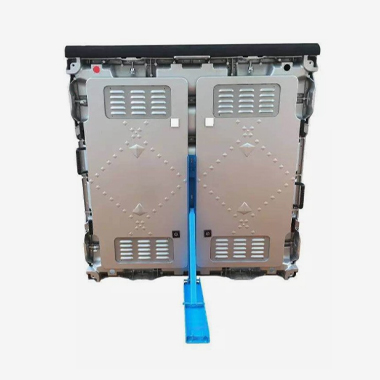
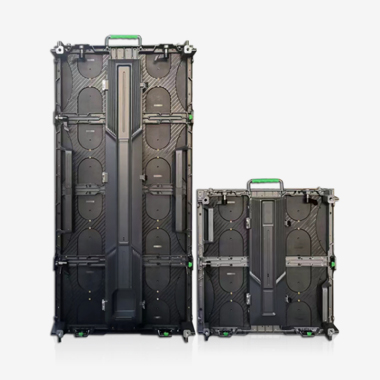
Durability First: Rental panels have extremely robust frames, typically constructed from lightweight but strong magnesium alloy or carbon-reinforced aluminum. These materials can withstand the bumps, drops, and vibrations of constant trucking and handling.
Weight Optimization: Every gram matters. Panels are designed to be as light as possible without sacrificing strength. A typical rental panel might weigh between 8-15 kg per square meter, significantly lighter than a fixed-install cabinet. This reduces shipping costs, minimizes the physical strain on crews, and allows for larger hangs from overhead trussing.
Quick-Connect Mechanisms: Speed is money in the rental business. Panels feature tool-less, quick-lock mechanisms that allow crew members to connect them together in seconds with a simple push and twist. These locks are over-engineered to ensure a secure, rattle-free connection that won't come loose during a show.
Integrated Rigging: Most rental panels have standardized, built-in rigging points that interface with a variety of industry-standard trussing systems. This allows for fast and safe flying of the video wall. For ground-supported systems, panels lock into sturdy, lightweight aluminum frames that provide a freestanding structure.
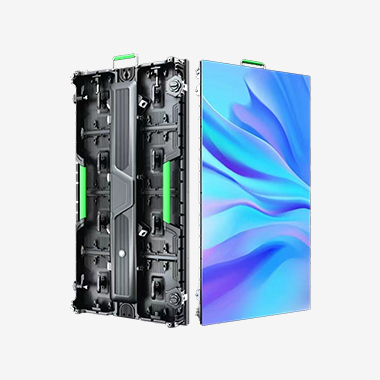
All-in-One Design (AIO): To simplify logistics and setup, rental panels are often "AIO," meaning the power supplies, receiving cards, and data routing are all integrated into the back of each panel. This eliminates countless external boxes and messy cabling, creating a cleaner, more reliable system. Cables are often daisy-chained from one panel to the next via robust, locking connectors.
The Critical Metric: Pixel Pitch and Resolution
The choice of pixel pitch is a strategic decision for a rental company, balancing image quality with versatility.
P4-P6mm: The workhorses of the industry. Ideal for large stages and arenas where the audience viewing distance is medium to long. They offer a great balance of resolution, brightness, and cost, making them the most common panels in rental inventories.
P2.5-P3.9mm: The standard for corporate events, broadcast, and medium-sized concert venues. This range provides a sharper image for audiences that are closer to the stage.
P1.9mm and Finer: High-resolution screens used for premium corporate events, broadcast, and front-of-stage applications where viewers may be very close. These are more expensive and fragile, and are often treated as a specialty item in a rental house's inventory.
Ruggedized Components:
LEDs and Modules: While using high-quality LEDs, the modules themselves are often designed for easy replacement in the field. A crew can swap a faulty module in minutes without needing to send an entire panel back to the shop.
Cabling: All cables use professional, locking connectors (like PowerCON for power and EtherCON for data) that are designed to prevent accidental disconnection and are built to withstand thousands of insertions and removals. Cables are also designed with generous lengths and service loops to accommodate various configurations.
Structural Systems: Ground Support and Flying
Ground Support Structures: These are lightweight, modular aluminum frameworks that panels bolt onto. They are engineered for stability, often with adjustable legs to accommodate uneven floors. They can be built in straight lines, curves, and even multi-story setups.
Flying Systems: For overhead suspension, panels are attached to a trussing system via specially designed rigging frames. This requires precise engineering to calculate the load and ensure the structure is safe. All components are certified and rated for their specific load capacities.
The Road Case: The Unsung Hero
Perhaps the most iconic symbol of the rental industry is the road case. LED panels are transported in custom-fitted, shock-absorbent flight cases. These cases are built from laminated plywood with aluminum edges, and feature foam interiors that are CNC-cut to cradle each panel perfectly. They protect the valuable electronics from the extreme conditions of travel and allow for efficient stacking and loading in trucks. A well-designed road case system is essential for maintaining the longevity of the investment.
Design for Serviceability:
Rental gear will fail; it's an inevitability given its harsh life. Therefore, it is designed for rapid troubleshooting and repair. Panels often have LED indicator lights that show power and data status, helping technicians quickly identify a problem. The modular nature means a single faulty panel can be replaced from the inventory without shutting down the entire display.
In summary, the design and construction of a portable rental LED wall is an exercise in applied ruggedness and logistical efficiency. There are no unnecessary frills; every feature, from the material of the frame to the shape of the connector, is purpose-built to endure the punishing cycle of load-in, setup, show, breakdown, and load-out, dozens of times a year, while still delivering a flawless, brilliant image under the intense pressure of a live event.
The working principles of a Portable LED Rental Display Wall share the same fundamental electronic foundation as all LED displays—controlling individual pixels through Pulse-Width Modulation (PWM). However, the operational paradigm is entirely different. The focus shifts from permanent calibration to rapid configuration; from centralized control to distributed, fault-tolerant networks; and from set-and-forget reliability to in-the-moment troubleshooting. This section breaks down the workflow, highlighting the processes that ensure these mobile systems perform flawlessly under the tight time constraints and unpredictable conditions of the event world.
The Workflow: From Truck to Show
Pre-Event Configuration: The Digital Twin: Before the physical wall is even unloaded from the truck, a crucial digital process begins. Using CAD software or specialized LED configuration tools, a video engineer designs the wall layout. This creates a "digital twin"—
Physical Layout: Defining the number of panels, their arrangement (e.g., 10 wide by 6 high, with a 15-degree curve), and their unique positions in the array.
Panel Mapping: Assigning a unique IP address or ID to each panel's receiving card within the software.
This configuration file is then loaded into the video processor. This pre-configuration saves invaluable time on-site.
On-Site Setup and Physical Addressing: Once the wall is built by the crew, the technical setup begins. While AIO panels simplify cabling (daisy-chaining power and data), the logical setup is key.
Data Distribution: A primary video processor sends the output signal to multiple "sending cards." From there, the data is distributed via Ethernet cables (often through network switches) to the first panel in each chain or zone.
The Daisy Chain: Data propagates from one panel to the next through the daisy-chained Ethernet cables. Each receiving card in a panel listens for data meant for its address and then passes the rest of the data down the line.
Automatic vs. Manual Addressing: Modern systems often feature automatic addressing. The processor can "discover" all the panels in the chain and assign them positions based on the physical layout. In other systems or for troubleshooting, technicians may need to manually set the address of each panel using DIP switches or software to match the pre-configured map.
Signal Processing and Scaling: The video processor is the brain of the operation. It performs several critical tasks in real-time:
Input Acceptance: It takes input from various sources—a media server for playback, a camera switch for live feeds, or a laptop for presentations.
Scaling and Layout Mapping: This is the most processor-intensive task. It takes the incoming video signal (e.g., a 1920x1080 feed) and maps it onto the unique, often non-standard resolution of the LED wall (e.g., 5120 x 2880 pixels). It correctly crops and assigns the right portion of the image to each panel based on the pre-loaded configuration.
Color Management: While not as meticulously calibrated as a fixed install, the processor applies basic color and brightness uniformity corrections to ensure a consistent look across all panels.
Data Handling and Redundancy: Reliability is non-negotiable. Rental systems are built with redundancy.
Ring Topology: A common setup for large walls is a data "ring." Instead of a single daisy chain that would fail if one cable was disconnected, the data path forms a ring. If a connection is broken at any point, the data can travel the other way around the ring to reach all panels, ensuring the show continues.
Backup Processors: For critical events, a primary and a backup video processor are used, with an automatic switcher that fails over to the backup instantly if the primary fails.
Power Distribution: Power is distributed from dedicated dimmer racks or distro boxes on stage. Each string of panels is protected by its own circuit breaker. Clean, stable power is essential to avoid flickering or damage to the sensitive electronics.
The Show: Control and Monitoring: During the event, an operator controls the content sent to the processor from a media server or presentation machine. Meanwhile, the video engineer monitors the health of the wall through the processor's software interface, which can display the status of each panel—temperature, voltage, and signal integrity—allowing for proactive management.
Troubleshooting Under Pressure: The working principle must include fault tolerance. If a single LED module or even an entire panel fails, the show must go on. Technicians are trained to quickly identify and bypass faulty units. The modular nature means a bad panel can be physically replaced during a show break if necessary.
In essence, the working principle of a rental LED wall is about creating a robust, flexible, and quickly reconfigurable network of display modules. It prioritizes speed of setup, resilience during operation, and ease of troubleshooting above the pixel-perfect calibration of a fixed install. It's a system designed to perform perfectly not in a controlled lab environment, but in the chaotic, time-sensitive, and high-pressure environment of a live event, where there are no second chances.
The portable LED rental model offers a compelling set of advantages that have made it the dominant force in event production. However, operating and utilizing this technology also comes with a distinct set of challenges and economic considerations. Understanding this balance is crucial for rental companies investing in inventory and for event producers planning their productions.
Advantages:
Unmatched Flexibility and Scalability: This is the paramount advantage. A rental inventory of LED panels is like a box of Lego bricks. They can be configured into a small 4x3 wall for a conference one day and reconfigured into a massive, curved 20x10 wall for a concert the next. This allows producers to create a custom-sized screen for every event without any permanent commitment, and rental companies to maximize the utility of their assets.
No Capital Investment for End-Users: For event producers, the rental model transforms a large capital expenditure (CAPEX) into a manageable operational expenditure (OPEX). They access multi-million dollar technology for the duration of their event without the burdens of ownership: maintenance, storage, insurance, and technological obsolescence.
Access to Expertise and Turnkey Service: When you rent an LED wall, you are not just renting hardware; you are renting expertise. Rental companies provide the skilled crews, technical directors, and operators who ensure the wall is built safely, configured correctly, and operated flawlessly. This mitigates risk and guarantees a professional outcome for the producer.
Technology Always Up-to-Date: The event industry is relentlessly competitive, and visual technology evolves rapidly. Rental companies are incentivized to continuously refresh their inventory with the latest pixel pitches, brighter LEDs, and lighter materials to stay competitive. This means event producers almost always have access to current technology without needing to sell and reinvest in their own outdated gear.
Durability and Reliability: As designed for the road, rental walls are built to be incredibly robust and reliable. They are tested to perform under demanding conditions and are maintained by professional technicians, giving producers confidence in their performance during critical live moments.
Logistical Mastery: Rental companies have the packaging (road cases), transportation (trucks), and warehouse infrastructure to move and store large quantities of equipment efficiently. This logistical capability is a huge value-add for producers who lack these resources.
Challenges and Considerations:
High Capital and Operational Cost for Rental Companies: The business model requires massive upfront investment in LED inventory, processing equipment, rigging, transportation, and storage. Profitability is achieved only through high utilization rates across the inventory. Furthermore, operational costs (maintenance, insurance, labor, fuel) are持续性的 (continuous).
Physical Logistics and Labor Intensity: Transporting tons of equipment requires large trucks and significant fuel. Setting up and tearing down large walls is physically demanding and requires large, skilled crews. Labor costs and availability are a constant challenge. The entire process is also time-consuming, often requiring long load-in and load-out schedules.
Warehousing and Maintenance Overheads: The inventory must be stored in a large, secure, and climate-controlled warehouse. A significant portion of a rental company's workflow is "in the shop"—testing, repairing, and refurbishing panels and cases after they return from an event to ensure they are perfect for the next one. This requires dedicated workshop space and technical staff.
Technological Obsolescence and Depreciation: LED technology improves rapidly. Panels purchased three years ago may already be considered a coarser pitch or less efficient than the newest models. Rental companies must constantly manage the lifecycle of their assets, deciding when to retire older gear and reinvest, a process that accelerates depreciation.
The "Race to the Bottom" in Pricing: The rental market can be highly competitive, leading to price pressure. While high-end providers compete on service and quality, there is a risk of commoditization where clients choose based on price alone, potentially squeezing margins and discouraging investment in the best equipment and crew.
Complexity for the Client: While the service is turnkey, the technology itself is complex. Clients must still provide clear briefs on their needs (viewing distance, content type, desired size) to ensure the rental company provides the appropriate pixel pitch and configuration. Miscommunication can lead to suboptimal results.
In conclusion, the portable LED rental model offers an incredibly powerful and efficient way to access cutting-edge visual technology. Its advantages of flexibility, financial accessibility, and expert service have made it the backbone of the event industry. However, this model shifts the burdens of investment, maintenance, and logistics to the rental companies, who must navigate a challenging business landscape of high costs, physical demands, and relentless technological change to provide their clients with a flawless ephemeral spectacle.
Portable LED rental walls have permeated every corner of the live event industry, becoming the default visual solution for creating impact and immersion. Their application continues to evolve as creatives find new ways to use this flexible medium. Simultaneously, technological and operational trends are shaping the future of how these walls will be used and managed. This section explores the current landscape of applications and the emerging trends that will define the next chapter.
Current Applications:
Live Music and Touring: This remains the largest and most visible application. Rental walls are used as:
Main Stage Backdrops: The classic large screen behind the artist, displaying custom content, live feeds, and graphic reinforcement.
Side Screens and Delay Towers: Ensuring audience sightlines in large festivals and arenas.
Stage Design Elements: Moving beyond a flat wall, panels are used to create overhead "lids," side wings, and even stage floors, enveloping the performer in a 270-degree visual environment.
Set Extension and AR: The wall provides the live backdrop for real-time augmented reality graphics used in broadcast feeds.
Corporate Events and Trade Shows:
Keynote Stages: Providing the dynamic backdrop for product launches, executive presentations, and shareholder meetings. The content is often a mix of slides, video, and live data visualizations.
Trade Show Booths: Creating high-impact, branded displays to attract attendees on the show floor. Their brightness ensures visibility in noisy convention hall lighting.
IMAG (Image Magnification): Large screens flanking the stage that show close-up shots of the presenter, ensuring engagement in large rooms.
Broadcast Television: Almost every major live broadcast event relies on rental LED.
Awards Shows (Oscars, Grammys): Elaborate, custom-shaped set pieces that form the entire environment of the show.
Talent Competitions (The Voice, America's Got Talent): Dramatic backdrops and interactive elements for performances.
Live Sports: Large screens in the studio for analysis, as well as temporary installations at sporting venues for special events.
Virtual Production: This is a rapidly growing application. Rental companies provide the LED panels to create temporary "Volumes" for film and television production. The ability to deploy a high-resolution curved wall quickly allows productions to shoot in multiple locations without building a permanent stage.
Future Trends:
Lighter, Stronger, and Thinner Panels: The relentless pursuit of weight reduction will continue. Advances in materials science (more magnesium alloy, composite materials) and more efficient LEDs and electronics will lead to panels that are easier, faster, and cheaper to transport and rig, enabling even larger and more creative configurations.
Higher Resolution in Rental Inventory: As the cost of finer-pitch technology decreases, the standard pixel pitch in rental inventories will shift downward. P2.5-P3.9 will become the new workhorse, replacing P4-P6, making high-resolution experiences accessible for a wider range of events.
Integration with XR (Extended Reality): Rental walls will become key components in live XR experiences. The physical LED wall will provide the primary environment and lighting for performers, while broadcast viewers will see an extended digital world composited around them in real-time. This requires perfect synchronization between the LED wall, camera tracking, and rendering engines.
Data-Driven Logistics and "Uberization" of Rental:
Asset Tracking: RFID and IoT sensors will be embedded in road cases and panels, allowing rental companies to track their inventory in real-time, predict maintenance needs, and optimize warehouse logistics.
Marketplaces: Online platforms may emerge that connect under-utilized LED inventory from rental houses with smaller clients, optimizing asset utilization across the industry.
Sustainability Initiatives: The environmental cost of trucking and powering large walls is under scrutiny. The industry will focus on:
Energy Efficiency: Adopting more efficient LED drivers and power supplies to reduce generator fuel consumption.
Local Sourcing: Touring productions will increasingly source gear from local rental houses in each market to minimize long-haul trucking.
Recycling and Upcycling: Developing better recycling programs for old panels and finding secondary markets for retired equipment.
Simplified Control and Automated Workflows: Software will continue to abstract away complexity. Setup wizards will make configuration faster, and AI-assisted tools could help automatically correct color imbalances or suggest optimal screen configurations based on a venue's dimensions.
The future of the portable LED rental wall is one of smarter, lighter, and more integrated systems. It will continue to be the essential canvas for live experiences, but its role will expand from a passive display to an active participant in creating blended physical-digital realities. The companies that succeed will be those that not only invest in the best technology but also in the sophisticated logistics and software needed to deploy it more efficiently and sustainably than ever before.
Conclusion
The portable LED rental display wall is a phenomenon that has fundamentally reshaped the aesthetics, economics, and very possibilities of live events. It is a technology that thrives on transience, built not for permanence but for powerful, fleeting impact. Its success lies not just in its ability to display light, but in its entire ecosystem—a seamless fusion of rugged engineering, logistical brilliance, and operational expertise that delivers visual magnificence on demand, anywhere in the world.
Its role as the great equalizer in the event industry cannot be overstated. By transforming a prohibitively expensive capital investment into an accessible operational cost, it has democratized large-format visual technology. A local corporate event can now harness the same type of screen that dominates a global stadium tour, albeit on a different scale. This accessibility has raised the bar for audience expectations, making dynamic, high-impact visuals a standard requirement rather than an expensive luxury.
The rental model itself is a masterpiece of efficient capitalism. It maximizes the utility of high-value assets, ensuring that this advanced technology is almost constantly in use, serving multiple clients and creating value across the industry. It incentivizes rental companies to maintain and continuously improve their inventory, driving technological advancement forward at a rapid pace. The competition among these companies benefits everyone, leading to better service, more innovative setups, and more reliable performance for event producers.
However, this conclusion must also acknowledge the immense effort hidden behind the spectacle. The flawless image on stage is the product of a hidden world of labor: the warehouse crews packing cases, the truck drivers navigating tight deadlines, the riggers hanging tons of gear with precision, and the technicians troubleshooting problems before they become crises. The portable LED wall is a testament to human skill and organization as much as to semiconductor innovation.
Looking forward, its indispensability is only assured. As the lines between physical and digital experiences continue to blur, the rental LED wall will be the primary platform upon which this fusion is built for live audiences. It will evolve to be lighter, sharper, and more intelligent, but its core purpose will remain: to provide a flexible, reliable, and breathtaking canvas for shared human experience.
In conclusion, the portable LED rental display wall is more than a product; it is a vital service and the indispensable engine of modern live spectacle. It is the ultimate tool for creating moments of wonder, communication, and connection. In a world increasingly mediated by small, personal screens, it reaffirms the power and magic of a vast, shared visual experience, proving that sometimes the most impactful technology is that which is built to appear brilliantly, and then vanish, leaving only the memory of its awe behind.


Copyright © 2026 Shenzhen Cogo Technology Co.,Ltd.
All Rights Reserved

 Previous article