




 Chat Now
LED display stage lighting signage represents the pinnacle of convergence in live event technology, merging the dynamic visual communication of digital signage with the atmospheric and dramatic power of stage lighting. This hybrid technology moves beyond the traditional role of a simple backdrop; it is an active, intelligent, and immersive environmental component that shapes narrative, directs audience attention, and generates profound emotional impact. Unlike standard LED video walls, which are primarily designed for displaying content, or conventional stage lights, which are designed for illumination and effect, this category exists at their intersection, using light as a content-rich, sculptural medium.
At its core, this technology involves the use of LED-based fixtures, panels, and elements that are capable of both displaying high-fidelity video content and functioning as a programmable light source. This includes, but is not limited to, traditional flat video walls, curved and flexible LED screens, transparent LED mesh, LED curtains, and individual intelligent LED fixtures (like video blades, cubes, and tubes). The key differentiator is intent and integration: these elements are not just showing a video; they are being used as light sources within a lighting designer's plot. They are patched into the lighting console (e.g., grandMA, Hog, Avolites) alongside moving lights and conventional fixtures, allowing a Lighting or Visual Designer to control both the intensity/color of the "fixture" and the video content it displays in a unified, synchronized manner.
The evolution towards this integration was inevitable. As stage design became more ambitious and audiences demanded more immersive experiences, the limitations of traditional tools became apparent. A static physical set is just that—static. A projector requires a surface to project onto and is defeated by ambient light. Standard LED walls are powerful but can feel like a separate, detached screen. LED stage lighting signage solves these problems by turning the set itself into a light-emitting, content-driven entity. The set becomes alive, responsive, and an integral part of the performance.
This technology is the driving force behind some of the most memorable contemporary live experiences. It is what allows a pop star to perform within a cube of light that displays swirling galaxies, enables a theatrical set to transform from a solid wall into a transparent window to another world, or lets a corporate stage pulse with brand colors and data visualizations that react to a speaker's words. It is the tool of choice for designers seeking to break down the barrier between the performer and their environment, creating a total, cohesive visual world.
This overview establishes LED display stage lighting signage as a distinct and powerful discipline. It is not merely about seeing a screen or being illuminated; it is about feeling within a constructed reality. The following sections will delve into the specific design considerations that make these systems so versatile, the technical principles that enable their dual function, the significant advantages they offer alongside their unique challenges, their vast and growing applications, and the future trends that promise to further blur the line between light and content.
The design and construction of LED elements for stage lighting signage are fundamentally guided by the demands of the live event environment. These components must be more than just good displays; they must be robust, lightweight, highly controllable, and designed for seamless integration into a lighting designer's creative toolkit. The philosophy shifts from creating a monolithic viewing screen to creating a modular, versatile, and often kinetic lighting instrument.
Core Component Design for Lighting Integration:
The Pixel as a Light Source: While a standard video wall pixel is designed for image resolution, a pixel in a stage lighting context is also evaluated as a raw light source. Designers consider its luminous flux (total light output), beam angle, and color rendering capabilities. Fixtures like LED blades or tubes often use larger, more powerful LEDs with wider viewing angles to function effectively as wash lights or beam lights, even when not displaying video.
Form Factors and Mechanics: This is where diversity shines. The construction varies drastically based on the intended use:
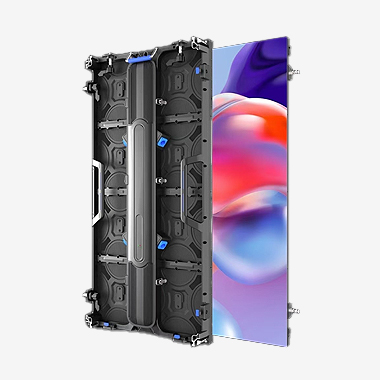
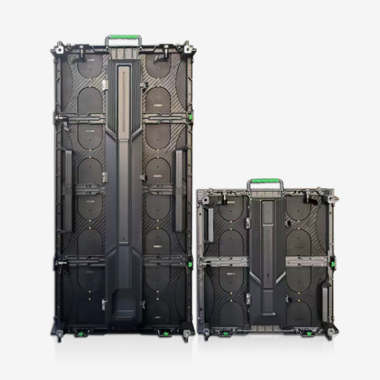
Traditional Video Walls: Built with lightweight, quick-assembly magnetic panels (e.g., 500x500mm). Their construction prioritizes rapid deployment, high resolution (P2.5-P4 for close viewing), and excellent color calibration for camera.
Flexible and Curved LED: Uses soft, malleable substrates that can be draped, wrapped around columns, or built into curved tunnels and arches. This allows the lighting set to adopt organic, non-rectilinear forms.
Transparent LED Mesh and Glass: Constructed with LEDs mounted on fine wires or within glass panels. This design allows them to be flown in front of performers or set pieces without completely obscuring the view, enabling layered visual effects and depth. They sacrifice some resolution for transparency but are invaluable for creating "holographic" and see-through effects.
Intelligent LED Fixtures: This includes products like the ROE V-Lite, CHAUVET® Professional EPIX™ series, or GLP JDC1. These are rugged, self-contained fixtures—often in strips, cubes, or tubes—designed to be mounted on trusses, flown, or placed on the deck. They are built like moving lights, with robust housings, integrated power/data pass-through, and motorized options for tilt and movement.
Control Integration Hardware: A critical design differentiator is the inclusion of hardware that translates lighting control protocols into video commands. Many modern LED panels and fixtures contain built-in processors that can accept DMX or Art-Net (standard lighting control protocols) directly. This allows a lighting console to send commands to change the fixture's mode: for instance, instructing it to switch from being a solid red wash light to playing a specific video clip from its internal memory, or to become a pixel-mapped element in a larger canvas. This eliminates the need for a separate video processor for basic functions, though complex content still requires one.
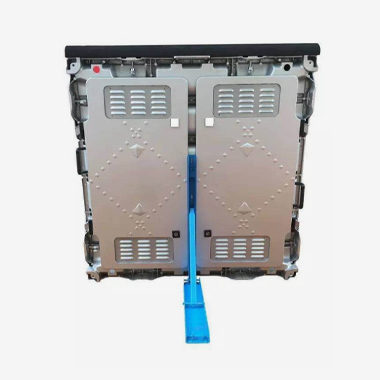
Durability and Safety: The construction must withstand the rigors of touring: constant vibration, setup, and tear-down. Connectors are robust and locking (e.g., EtherCON, PowerCON). Materials are lightweight yet strong, using aluminum alloys and reinforced plastics. Crucially, everything is designed for safe rigging. Fixtures have integrated rigging points and are rated for overhead use, with safety cables being a mandatory part of the system.
The Content Pipeline Design:
The "signage" aspect necessitates a sophisticated content management workflow. Unlike a simple logo display, this involves:
Media Servers: Powerful computers (e.g., disguise, Green Hippo, AVOLITES) that store and manage all video content. They are the bridge between the creative vision and the hardware. They handle tasks like:
Pixel Mapping: The process of assigning specific content to specific groups of LEDs, treating a collection of disparate fixtures as a single, coherent canvas.
Warp and Blend: Correcting geometry for non-flat surfaces.
Cueing: Working in sync with the lighting console, the media server triggers video clips, effects, and transitions in perfect time with the lighting cues.
Calibration: Meticulous color and brightness calibration across all LED elements is non-negotiable. A lighting designer demands consistency; a patch of tiles that is a different shade of white will break the illusion and be rejected as a viable light source.
The design and construction of these systems are therefore a holistic exercise in merging video engineering with lighting fixture design, all wrapped in a package that meets the brutal practical demands of the live event industry.
The working principles of LED display stage lighting signage revolve around the seamless integration of two traditionally separate data streams: video signals and lighting control protocols. The magic happens in the translation layer, where commands from a lighting console are interpreted to manipulate both the intensity and the content of the LED elements.
The Unified Control Architecture:
The Lighting Console as Conductor: The process starts at the lighting console. The designer writes cues that may include instructions for a group of LED panels. Instead of just setting a dimmer level and color, the cue might also contain a command like "Play Video Clip Explosion_02" or "Activate Effect Pixel Chase Red." This command is packaged into a lighting protocol, most commonly DMX or Art-Net (Ethernet-based DMX).
Data Distribution and Protocol Translation: The DMX/Art-Net data is sent over a network to the LED fixtures. This is where the built-in intelligence of the fixtures comes into play. A traditional LED panel requires a dedicated video processor to receive a video signal (HDMI, DVI) and break it down into data for the receiving cards. In contrast, an advanced "lighting-led" fixture has a small onboard computer that can interpret DMX commands directly.
In DMX Mode, the fixture might use a few DMX channels to control its basic functions: e.g., Channel 1: Dimmer, Channel 2: Red, Channel 3: Green, Channel 4: Blue, Channel 5: Strobe. In this mode, it behaves exactly like a standard RGB LED fixture.
In Media Mode, a block of DMX channels is used to control content playback. For example, DMX channels might be assigned to select a pre-loaded video clip from the fixture's internal SD card, control the clip's playback speed, set transparency, or trigger an effect.
Pixel Mapping - The Bridge Technique: For complex content across a large array of fixtures, a media server is essential. The media server holds the library of video content. The lighting designer's console sends commands to the media server (via a protocol like MSC - Media Server Control) telling it what to play and when. The media server then handles the heavy lifting: it generates the actual video signal, but it does so based on a pre-configured "patch."
This patch is a virtual map of the entire stage's LED elements. The media server knows the exact pixel address, size, and physical location of every LED fixture. When it is told to play a video, it intelligently slices, dices, warps, and maps that video onto the virtual canvas, and then outputs the correct data to each individual fixture or video processor. This allows a single video file to be stretched seamlessly across a entire set made of different shaped pieces.
The Role of Timecode: For large, pre-planned shows (concerts, theatre), absolute synchronization is achieved through timecode. The lighting console, media server, audio console, and automation systems all lock to a single timecode source. Every cue—every light movement, every video clip start, every audio hit—is triggered at a precise moment in the timecode. This ensures perfect synchronization night after night, even if a human operator is slightly late pressing a "go" button.
Real-time Manipulation and Effects: Beyond playing pre-rendered clips, the system can generate effects in real-time. The lighting console can send DMX data to control parameters like color saturation, contrast, or the speed of a generative noise effect on the media server. This allows the lighting operator to "perform" the visuals live, reacting to the energy on stage rather than just playing back a pre-recorded sequence.
In essence, the working principle is about creating a hierarchical, networked control system. The lighting console provides the high-level "what to do" commands, and either the fixtures' onboard intelligence or a dedicated media server handles the complex "how to do it" tasks of processing and distributing video data. This fusion creates a responsive, cohesive, and breathtakingly synchronized visual experience.
The integration of LED displays into the lighting designer's arsenal offers transformative advantages, but it also introduces a layer of technical and creative complexity that must be carefully managed.
Advantages:
Unprecedented Creative Freedom and Dynamism: This is the paramount advantage. Designers are no longer limited by static sets. The environment can change instantly—from a solid structure to a transparent one, from a textured surface to a video portal to another world. It allows for a kinetic, living set that responds directly to the performance, driving the narrative forward with visual power that static scenery cannot match.
Unification of Design Disciplines: It breaks down the silos between lighting, video, and set design. A single designer, or a closely-knit team, can now control the entire visual landscape from one platform. This ensures a totally cohesive look and feel, where the content on the screens and the lighting on the performer are perfectly matched in color, mood, and timing.
Space and Weight Efficiency: A single LED wall can replace dozens of moving lights, scenic flats, and projection surfaces. It consolidates functionality, which can simplify rigging, reduce truck space, and minimize setup time. A transparent LED wall can serve as both a downstage scenic element and a projection surface for upstage effects, all in one.
Enhanced Atmosphere and Immersion: Because the LED surfaces are themselves bright light sources, they contribute significantly to the stage wash and ambient light. This means the performers are lit from within the set itself, creating a more natural and immersive environment than having isolated actors separate from a glowing backdrop. The light and the image are one.
Brand Integration and Storytelling: For corporate events, the ability to turn the entire stage into a dynamic brand canvas is invaluable. Logos, colors, and marketing messages can be woven directly into the lighting design, creating a powerful and consistent brand experience that permeates the entire event.
Challenges:
Exponential Technical Complexity: This is a significant challenge. Integrating video and lighting networks requires expertise in both domains. Troubleshooting issues can be a nightmare; is a black tile a DMX addressing problem, a network switch failure, a power issue, or a media server error? It demands a crew with hybrid skills and deep knowledge.
Significant Cost: The investment is substantial. High-quality, lighting-integrated LED fixtures, media servers, and the powerful network infrastructure required are expensive. This is compounded by the need for highly skilled programmers and operators, who command higher rates due to their specialized knowledge.
Content Creation Demands: The need for custom, high-quality content is immense and ongoing. A show cannot run on a few stock videos. Content must be designed specifically for the unique canvas, which often has non-standard aspect ratios and may be warped across 3D shapes. This requires a team of motion graphics artists working in tandem with the lighting designer, adding to the pre-production timeline and cost.
Heat and Power Management: A large LED setup is a small power plant. It draws massive amounts of electricity and generates significant heat. Venues must have adequate power distribution, and careful planning is needed for cooling to prevent the LEDs from overheating, which can lead to failure and color shift.
The "Unlit" Challenge: A traditional blackout on stage is achieved by turning off the lights. However, an LED wall, even showing black, is often still emitting a low level of light (a function of how LEDs and processors work). Achieving a true, deep blackout requires either turning the entire wall off (which can cause boot-up delays) or using a separate scenic curtain or system to mask it, adding another layer of complexity.
Despite these challenges, the advantages are so compelling that LED display stage lighting signage has become the standard for high-end productions. The ability to create a truly dynamic and immersive visual world outweighs the increased complexity and cost, pushing the entire industry toward greater technical and artistic innovation.
The application of LED display stage lighting signage is vast and growing, revolutionizing how stories are told and experiences are crafted across numerous domains. Simultaneously, the technology is evolving rapidly, pointing toward an even more integrated and intelligent future.
Diverse Applications:
Concert Touring: The primary driver of innovation. Major artists use these technologies to create iconic visual identities for their tours. This includes everything from vast, curved video walls that act as the main stage to intricate setups of intelligent LED fixtures (tubes, cubes, blades) that form moving, light-emitting sculptures around the performers.
Broadway and West End Theatre: Theatrical productions have embraced the technology for its transformative power. LED panels are used to create dynamic backdrops that can change from a realistic location to an abstract emotional landscape in a cue. Transparent LED screens are used for dream sequences and magical effects, allowing actors to be seen behind the video imagery.
Corporate Events and Product Launches: Used to build brand immersion. Keynote stages are surrounded by LED walls that display data visualizations, product demos, and brand content that reacts to the speaker. The "reveal" of a new product is often a choreographed spectacle of light and video on an LED-based set.
Television and Award Shows: Shows like the Grammys, Oscars, and Eurovision use increasingly complex LED stages to create a spectacle for the broadcast audience. This includes LED floors, ceilings, and all surrounding surfaces, placing the hosts and performers inside a completely digital environment.
Nightclubs and Immersive Experiences: Clubs use LED technology to create immersive environments. This includes LED dance floors, bars, and walls that pulse with music-reactive content, enhancing the sensory experience for patrons.
Architectural Installation and Art: Moving beyond the stage, artists are using these tools for permanent and temporary installations in public spaces, museums, and galleries, creating interactive experiences that blend digital art with physical space.
Future Trends:
Volumetric Capture and Display: The next frontier is moving from 2D surfaces to true 3D displays. This involves using dense arrays of LEDs to create light fields that can render volumetric visuals, allowing for 3D objects and characters to appear in physical space without the need for glasses. This would be a revolutionary step for live entertainment.
Advanced XR and Virtual Production: The use of LED walls as in-camera backgrounds (as seen in The Mandalorian) will become more sophisticated and accessible. This virtual production technique allows for real-time rendering of photorealistic environments, enabling filmmakers and broadcasters to achieve unprecedented realism and creative flexibility without leaving the soundstage.
Greater Integration with AI and Real-Time Rendering: AI will be used to generate and manipulate content in real-time based on various inputs: audio analysis of the music, movement tracking of performers, or even data feeds from the internet. This will lead to truly generative, never-repeating visual performances.
Improved Transparency and Flexibility: Transparent OLED and MicroLED technologies will offer higher resolution and better transparency, making "invisible" screens that only light up when needed a reality. Flexible displays will become more robust and affordable, enabling even more organic and innovative stage designs.
Sustainability Focus: The industry will drive towards more energy-efficient LEDs, better power management systems, and fixtures made from recyclable materials. The long lifespan and reduced need for consumables (like gel and lamp replacements) already offer a sustainability advantage over conventional lighting that will be further optimized.
The future of LED display stage lighting signage is one of deeper integration, smarter control, and more breathtaking realism. It is moving from being a tool to create a background to becoming the very environment itself—an intelligent, responsive, and immersive world that is limited only by the imagination of the creators.
Conclusion
In conclusion, LED display stage lighting signage is not merely an incremental improvement in event technology; it represents a fundamental paradigm shift in how we conceive of and execute visual storytelling in live environments. It has successfully dismantled the historical boundaries between lighting, video, and scenic design, fusing them into a single, powerful discipline. This convergence has given birth to a new era of production value, where the stage is no longer a static place but a dynamic, emotional, and narrative character in its own right.
We have explored the intricate design and robust construction that makes these tools both versatile and reliable enough for the demanding live event industry. The working principles, centered on the sophisticated marriage of lighting control protocols and video data streams, reveal a level of technical integration that was unimaginable a decade ago. The advantages are undeniable: unparalleled creative freedom, immersive environments, and a unified visual language. Yet, these come with the sobering challenges of heightened complexity, significant cost, and an immense demand for specialized content and expertise.
The applications are already vast, from defining the world's biggest concert tours to enabling the magical transformations of modern theatre. And as we look to the future, the trends point toward even more groundbreaking possibilities—volumetric displays, AI-driven content, and seamless virtual production—that promise to further erase the line between the physical and the digital.
Ultimately, LED display stage lighting signage has redefined the role of technology in performance. It has moved from being a supportive utility to being a central creative partner. It empowers artists and designers to build worlds, evoke emotions, and tell stories with a visual vocabulary that is richer and more expressive than ever before. It is the undeniable present and the exhilarating future of live visual experience, setting a new standard that audiences will now expect and demand. The stage has truly come alive.


Copyright © 2026 Shenzhen Cogo Technology Co.,Ltd.
All Rights Reserved

 Previous article