




 Chat Now
Indoor LED rental display panels form the backbone of the modern events industry, providing the dynamic, scalable, and high-impact visual canvas that defines contemporary experiences. Unlike their fixed-installation counterparts, these panels are designed for mobility, rapid deployment, and reconfiguration, making them the go-to solution for a vast array of temporary events. From corporate product launches and concert tours to trade show booths and conference keynotes, rental LED walls transform spaces, amplify messages, and create immersive environments that captivate audiences.
The core philosophy of rental LED technology is flexibility. A single inventory of panels can be used to create a massive, wide-format backdrop for a concert one night and be reconfigured into a complex, multi-faceted display for a corporate meeting the next day. This versatility is what makes the rental model so powerful and economically viable for rental companies. The technology must be robust enough to withstand the rigors of transportation and frequent assembly/disassembly, yet lightweight and user-friendly enough to be set up quickly by a skilled crew.
The market is driven by the ever-increasing demand for high-quality visual production. Audiences, accustomed to high-definition screens in their daily lives, expect nothing less from live events. This has pushed rental technology towards finer pixel pitches, higher refresh rates, and better color consistency to ensure camera-friendliness for live broadcasting and social media content creation. The success of an event often hinges on the seamless integration and flawless performance of these visual components.
A key differentiator in the rental market is the ecosystem surrounding the panels themselves. It's not just about the LEDs; it's a complete system that includes flight cases for safe transport, specialized rigging hardware (like truss and motors), quick-connect data and power cabling, and sophisticated video processors. The value provided by a rental company lies in its ability to deliver a turnkey solution: the hardware, the technical expertise to design the screen setup, and the crew to install, operate, and dismantle it safely and efficiently.
The evolution of rental displays has moved from heavy, cumbersome modules to today's lightweight, fine-pitch panels that offer incredible image quality. Modern rental panels are designed with the end-user—the video technician and the rigger—in mind, featuring tool-less assembly, automatic locking mechanisms, and intuitive calibration software. This focus on user experience reduces setup time, minimizes the potential for error, and ensures a perfect alignment and color match across the entire display surface.
In summary, indoor rental LED displays are more than just a product; they are a dynamic service enabler. They are the essential tool that allows event producers to realize their creative vision, build brand experiences, and emotionally engage with their audience through the power of large-format, high-resolution digital imagery.
The design and construction of an indoor rental LED panel is a masterclass in balancing performance with practicality. Every aspect is optimized for three core tenets: durability for travel, speed of setup, and exceptional image quality.
A. Core Components and Materials:
LED Modules: The heart of the panel. For rental, -in-1 SMD (Surface-Mount Device) LEDs are overwhelmingly the standard due to their excellent color mixing, wide viewing angles, and reliability.
PCB and Mask: The modules are built on a robust FR-4 PCB. A matte black face mask is critical for enhancing contrast by absorbing ambient stage light that would otherwise wash out the image.
Protection: While not potted like outdoor panels (which would add weight and hinderhot), the modules are coated with a protective conformal coating to guard against humidity and dust during short-term use.
Cabinet Design: This is where rental-specific engineering shines.
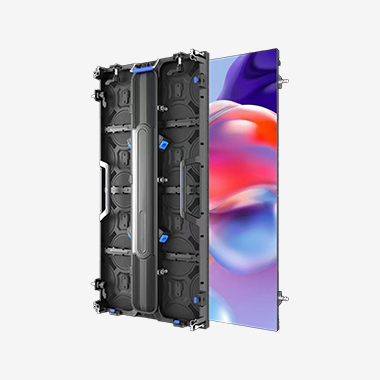
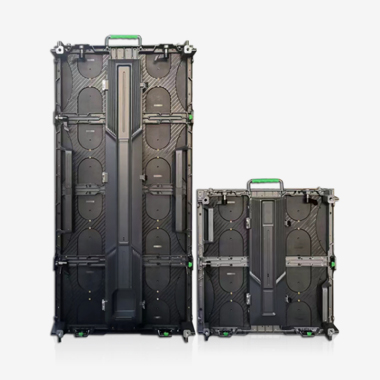
Lightweight Materials: The cabinet frame is almost exclusively made from high-grade, lightweight magnesium alloy or aluminum. This reduces the weight of each panel significantly, making it easier for crews to handle and reducing transportation costs.
Size and Form Factor: Common sizes are 500x500mm or 500x1000mm, offering a good balance of manageability and reducing the number of seams in the final image. "All-in-One" panels integrate the power supply, receiving card, and processors directly into the cabinet, eliminating external boxes and simplifying cabling.
Quick-Connect Locking System: The most crucial feature for speed. Panels employ a patented mechanical locking system (e.g., NDI®, MaxiLock, MechLock) that allows technicians to connect panels together quickly, securely, and without any tools. A lever-based mechanism pulls panels into perfect alignment horizontally, vertically, and on the Z-axis (depth), ensuring a smooth, seamless display surface.
Integrated Data and Power Pass-Through: Cabinets have built-in ports for data and power inputs and outputs. Cables are designed with robust, locking connectors (like Harting or Aviation-style connectors) that are easy to plug in, resist accidental disconnection, and are routed neatly behind the panels to maintain a clean look.
Rigging and Flying Hardware: Rental panels are designed to be flown from truss systems using chain motors. Integrated rigging points on the cabinets allow for the attachment of a flying frame or dedicated rigging hardware that distributes the weight of the entire screen array safely and securely. Safety is paramount, with multiple redundant safety locks.
B. Thermal Management:
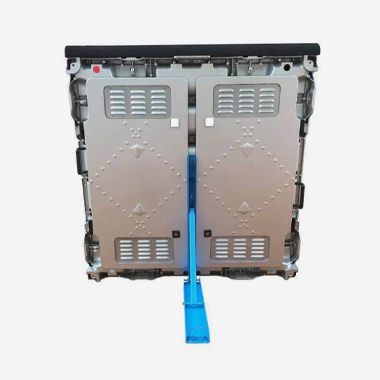
Indoor environments lack the extreme temperatures of outdoors, but heat is still the enemy of LED lifespan. Rental cabinets use passive cooling designs. The lightweight metal cabinets act as a large heat sink. Strategically placed ventilation slots allow for convection cooling—hot air naturally rises and escapes, drawing in cooler air from below. This eliminates the need for fans, which are a point of failure, add weight, and generate unwanted noise in quiet event settings.
C. The Supporting Ecosystem:
Flight Cases: Custom-foamed, wheeled road cases are non-negotiable. They protect the sensitive panels during the often-brutal transportation process. A well-designed case will have specific foam cutouts for each panel, cables, and accessories.
Calibration Tools: Rental companies use dedicated colorimetric photometers and software to ensure every panel in their inventory is perfectly matched for color and brightness. This allows panels from different batches or even different manufacturers to be combined into a single, uniform wall.
The construction of a rental panel is a testament to industrial design focused on the user. It prioritizes speed, safety, and reliability without compromising on the visual fidelity that the event industry demands.
The fundamental working principles of an indoor rental LED panel share a common foundation with all LED displays—electroluminescence and digital control—but the rental environment imposes specific requirements on signal handling, calibration, and reliability.
A. Image Creation: The Pixel and Color Mixing
Each pixel on the display is a cluster of red, green, and blue (RGB) micro-LEDs. When a current is applied to these semiconductor diodes, they emit light through electroluminescence. By independently controlling the intensity of each colored diode within a pixel, the display can create any color in the visible spectrum through additive color mixing. The intensity of each LED is not controlled by varying voltage but by Pulse-Width Modulation (PWM). This technique rapidly cycles the LED on and off thousands of times per second. The human eye perceives a longer "on" pulse within each cycle as a brighter light. This precise control allows for deep blacks and a high grayscale range, creating smooth, lifelike images.
B. The Signal Chain and Data Management:
Content Source: Video content is played from a media server or a computer using professional software (e.g., disguise, Resolume, Watchout). This source outputs a standard video signal (often HDMI or SDI).
Video Processing: This is the brain of the operation. The video signal is sent to a powerful dedicated LED processor (e.g., Novastar, Brompton, Colorlight). This processor performs several critical tasks:
Scaling and Resolving: It maps the input video resolution to the native, non-standard resolution of the entire LED wall.
Color & Brightness Management: It applies color calibration data (see below) to ensure uniformity across every panel.
Sending Data: It splits the complete image data into smaller chunks corresponding to the individual receiving cards in each LED cabinet. This data is typically sent over high-bandwidth network cables (using protocols like Art-Net, sACN, or proprietary protocols) from the processor's output ports.
Panel-Level Processing: Each LED cabinet contains a receiving card. This card gets its specific piece of the overall image from the processor and is responsible for driving the LEDs on its connected modules. It translates the data into commands for the driver ICs (integrated circuits) on the module, which in turn execute the PWM signals for the individual LEDs.
C. Calibration: The Key to Perfection
For a rental wall, consistency is everything. Panels are used in different combinations for every event. Therefore, a one-time factory calibration is not enough.
The Process: A rental company uses an external calibration device (a photometer) and software. The device is placed in front of each panel to measure the output of its red, green, and blue LEDs at various brightness levels.
Creating a Profile: The software detects any deviations from a desired color standard (e.g., D65 white point) and creates a unique calibration file for that specific panel. This file contains compensation values to make its output perfectly match all other panels in the inventory.
Loading the Profile: This calibration file is stored directly on the panel's receiving card. When the wall is powered on, each panel automatically applies its unique corrections. The result is a vast canvas that appears as a single, perfectly uniform screen with no color or brightness shifts between panels, even if they are from different manufacturing batches.
This combination of robust electronic design, sophisticated signal processing, and meticulous calibration ensures that an indoor rental LED wall delivers a stunning, reliable, and seamless visual experience show after show.
The adoption of rental LED technology has revolutionized event production, but it presents a unique mix of powerful advantages and operational challenges that rental companies and production managers must navigate.
Advantages:
Unparalleled Creative Flexibility: This is the foremost advantage. Rental LED can be configured into virtually any shape and size—from massive, flat walls to curved tunnels, arches, columns, and even 3D structures. This allows set designers to break free from the constraints of a fixed, rectangular screen and create truly immersive environments.
Exceptional Image Quality: Modern rental panels offer fine pixel pitches (P2.9, P2.6, and even sub-P2.0), resulting in high-definition and ultra-high-definition imagery that remains crisp even at close viewing distances. High refresh rates (3840Hz+) make them perfectly camera-friendly, eliminating rolling shutter effects for broadcast and live streaming.
Rapid Deployment and Scalability: Designed for speed, a large LED wall can be assembled by a experienced crew in a matter of hours, not days. The modular nature means the display can be easily scaled up or down to fit different venue sizes and budgets by simply adding or removing panels.
Cost-Effectiveness for Temporary Events: For a one-off event, conference, or tour, renting is vastly more economical than purchasing. It eliminates massive capital expenditure, storage costs, and the risk of technological obsolescence. Clients pay for the technology only for the duration of their need.
Professional Support and Guaranteed Performance: Renting from a reputable company includes more than just hardware. It includes the technical expertise to design the system, the crew to install it correctly, and the assurance that the equipment is fully tested, calibrated, and backed by on-site support. This significantly reduces the risk and technical burden on the event organizer.
Challenges:
Logistical Complexity and Transportation: Managing a large inventory of panels, flight cases, truss, and cables requires immense logistical planning. Transportation costs are high, and the risk of damage in transit is ever-present. Coordinating load-in, setup, and load-out schedules with a venue can be tight and stressful.
Physical Labor and Crew Requirements: Despite being lightweight, assembling a large wall is physically demanding work that requires skilled, certified technicians—not just for the LED assembly but also for the rigging and electrical work. Labor costs are a significant part of the overall rental expense.
Cost and Maintenance of Inventory: For the rental company, the initial investment in a high-quality, fine-pitch rental inventory is enormous. Furthermore, maintaining that inventory—repairing damaged panels, updating technology, replacing cables and cases—represents a continuous operational cost.
Technical Complexity and Failure Points: While the systems are designed for reliability, the complexity of the signal chain (processors, network switches, hundreds of cables and connections) introduces multiple potential points of failure. A single faulty cable or connector can cause a entire section of the wall to black out, requiring skilled troubleshooting during critical setup times.
Client Education and Content Management: A common challenge is managing client expectations regarding resolution and content design. Content must be designed at the exact resolution of the LED wall, not a standard 16:9 ratio. Low-resolution images or videos will look poor when stretched across a large fine-pitch wall. Educating clients on these technical requirements is an ongoing task.
Ultimately, the advantages of visual impact and flexibility far outweigh the challenges for most events. However, success depends on partnering with an experienced rental provider that can expertly manage the inherent complexities of the technology.
The application spectrum for indoor rental LED is incredibly diverse, driven by its core attributes of flexibility and high impact. Simultaneously, technological and market trends are continuously shaping its future, pushing towards greater integration and intelligence.
Applications:
Live Concerts and Music Tours: This is a flagship application. LED walls are used as dynamic stage backdrops, displaying immersive visuals, live camera feeds of the performers, and interactive graphics that synchronize with the music. They are essential for creating the spectacular visuals audiences expect from major touring acts.
Corporate Events and Trade Shows: For product launches, annual meetings, and shareholder conferences, LED walls provide a powerful branding tool and a clear stage backdrop for presentations. In trade show booths, they are used to attract attention, demonstrate products, and create an engaging environment that stands out on a crowded show floor.
Broad Television and Awards Shows: Events like the Grammy Awards, Oscars, and major sporting event ceremonies rely on massive, complex LED setups to create their iconic stage designs. The technology must be camera-ready to provide glitch-free, shimmer-free images for the broadcast feed seen by millions.
Esports Tournaments and Gaming Conventions: The gaming world is inherently digital, and LED walls are the perfect medium to display the action to live audiences. They create an arena atmosphere, showing the game play, player stats, and sponsor messages with high energy and vibrancy.
Virtual Production Studios: This is one of the fastest-growing and most revolutionary applications. Large, curved LED walls (often called "Volumes") are used as real-time digital backdrops for film and television production. Actors perform in front of the screen, which displays photorealistic CGI environments that interact with the lighting on set, eliminating the need for location shooting and green screens.
Future Trends:
Even Finer Pixel Pitches and MicroLED: The race towards smaller pixels will continue. MicroLED technology, which uses microscopic, individual LEDs, will become more prevalent in rental. This will enable direct-view LED walls with pixel pitches below 1.0mm, rivaling the image quality of OLED TVs and expanding applications into ultra-close-viewing scenarios.
Chip-on-Board (COB) Technology: COB technology, where the LED chips are directly mounted onto the PCB and then coated with a protective phosphor layer, is gaining traction. COB offers superior reliability (more resistant to physical impact and moisture), better heat dissipation, and a smoother visual appearance with no visible black lines between pixels.
Enhanced Virtual Production Integration: The tools for virtual production will become more sophisticated and accessible. Integration with game engines like Unreal Engine will be seamless, and panels will be optimized for higher color fidelity (Rec. 2020 color space) and higher refresh rates to perfectly serve this booming market.
Lighter, Thinner, and Brighter Panels: The pursuit of weight reduction will persist, using new materials and more efficient components to make handling even easier and reduce shipping costs. Panels will also become thinner (slimmer bezels and cabinet depth) for a more seamless look and brighter for use in environments with higher ambient light.
Smarter Panels and IoT Integration: Panels will become more intelligent. Built-in sensors could monitor temperature and performance in real-time, sending alerts for potential issues before they cause downtime. Automated calibration via embedded sensors could further simplify and speed up the setup process.
The future of indoor rental LED is pointed towards higher fidelity, greater robustness, and deeper integration into creative and technological workflows, solidifying its role as the ultimate visual tool for live experiences.
Conclusion
Indoor rental LED display panels have evolved from a novel visual effect to the absolute cornerstone of modern event production. They have fundamentally altered the aesthetics and possibilities of live experiences, providing a dynamic and malleable digital canvas that empowers creators to build worlds, amplify narratives, and connect with audiences on a deeper emotional level. Their value proposition is undeniable: unparalleled flexibility, stunning visual clarity, and the economic logic of a rental model that provides access to cutting-edge technology without the burden of ownership.
The success of this technology is not merely a story of improving semiconductors; it is a story of user-centric design. The development of quick-connect systems, lightweight materials, and sophisticated calibration processes has been driven by the practical needs of the rental industry—speed, reliability, and consistency. This focus has turned a complex technological system into a manageable tool that can be deployed reliably under the tight deadlines and high-pressure environment of live events.
While challenges around logistics, cost, and technical complexity remain, they are effectively managed by a mature and professional ecosystem of rental houses, technicians, and content creators. The ongoing trends point towards a future where these displays become even more visually seamless, intelligent, and integrated into new fields like virtual production, which is itself redefining content creation.
In conclusion, the indoor rental LED panel is more than just a display; it is an enabling technology for storytelling. It has broken down the physical barriers of the stage, allowing the digital and physical realms to merge. As the technology continues to advance, becoming finer, brighter, and smarter, its role as the indispensable visual engine for concerts, conferences, broadcasts, and virtual sets will only grow more profound. It has permanently illuminated the landscape of live events, and its future continues to look brilliantly bright.


Copyright © 2026 Shenzhen Cogo Technology Co.,Ltd.
All Rights Reserved

 Previous article